From Skeptics to Believers: How We Get Clients to Play with Applied Improvisation
Written by Raymond van Driel – This article is from AIM Issue 3 (released July 2025).

In February 1998, I finally got the chance and met with a CEO to discuss applied improvisation.
He seemed distracted, rattling off his corporate challenges like “breaking silos” and “inclusive leadership.” I didn't understand, hesitated, unsure when to introduce improvisation.
Finally, he asked, “So, what’s this improvisation about?”
Nervously, I answered, “Saying YES, and fostering collaboration!”
He checked his watch. “An example?”
Sweating, I blurted out, “We stand in a circle and pass a clap! And if you want, you can say BOINNGG, and then it bounces!”
Silence.
Three minutes later, I was back on the street, realizing I had completely failed to communicate the true power of improvisation.
As facilitators, trainers, and practitioners of Applied Improvisation, we’ve all experienced its transformative power. Yet, explaining it can feel like stepping into an improv scene with a hesitant audience. We've encountered skeptical glances, polite nods, and the classic question: “Ehm ... isn’t that just for comedians?”
Applied Improvisation is so much more than theater games. It’s a mindset, a toolkit, a set of skills and a way of navigating challenges with creativity, agility, and confidence. Still, we often face the same challenge: how do we help others—our colleagues, our clients, and our non-improv friends—recognize and connect with these benefits in a way that feels relevant and meaningful to them?
There are multiple frameworks and approaches out there, each with its own strengths depending on the
audience. Through experience, we’ve explored and adapted many different approaches. One approach that has been helpful for me in engaging clients and making improvisation tangible is the PLAY! model - a mnemonic that encapsulates key aspects of the improvisational mindset and skills. I created the model in 2013 with some of my clients and it has proven useful in various settings. I'm proud that it has even been adopted by 14 universities worldwide as part of their leadership and innovation programs. I hope it might also support you!
Using the PLAY! Model
The PLAY! model offers a simple, structured way to teach the core skills and mindset of improvisation. Its five elements—Presence, Leap Into It, Accept and Adapt, Yes, And…, and Impact!— represent fundamental underlying aspects and the mnemonic makes it ‘sticky – people remember. It helps clients connect applied improvisation to their personal and professional lives and allows them to easily connect with its principles and apply them in their own contexts.
Let’s take a closer look.
- P - Presence: This is about fully engaging in the here and now rather than being distracted by future worries or past concerns. Being present means tuning into your surroundings, the people in the room, and your own reactions. This deep presence allows us to genuinely connect with our partners, groups, clients, and perhaps your market. At Maastricht University's school for entrepreneurs, we encourage students to connect with their prospects early, engaging in conversations about their needs rather than isolating themselves behind a laptop, first creating their business plans in solitude and only then find out if someone's interested.
- L - Leap Into It: Improvisation is about action over hesitation. Many professionals struggle with over-planning and reluctance to take risks. This skill and mindset encourages stepping into uncertainty, embracing mistakes, and faster learning and adapting to change through doing. It helps participants experience how forward momentum creates new possibilities. People seem to fall into only one of two distinct approaches: those who excel at avoiding failure and those who are error tolerant and confident that they'll adapt when things are going another way than wanted or expected.

- A - Accept and Adapt: A positive attitude towards change is essential in improvisation. Yet, people don't like change, even worse when they are changed by others by for example management or HR. Even when the change is clearly in their advantage. However, when we learn to navigate and embrace change, we build flexibility and resilience. This involves opening ourselves to new perspectives, adapting to unexpected situations, and seeing transitions—whether in life or work—not as obstacles but as opportunities for growth.
- Y - Yes, And...: This is the foundation of constructive collaboration. Instead of blocking or negating ideas ("Yes, but ..."), we practice appreciating offers and building on them. The distinction is clear; with a Yes, and - mindset, we see more positive collaboration, more energy, more ‘flow,’ more connection, more spontaneity and more fun. This also switches focus away from problem details and toward solutions. It also prevents premature discarding of valuable ideas by creating room to explore them further.
- ! - Impact!: Ultimately, Improvisation isn’t just about reacting - it’s about stepping up. When we commit fully to our actions, whether in storytelling, problem-solving, or leadership, we create stronger outcomes. This element highlights the balance between stepping up with confidence, engagement, and boldness, and knowing when to follow and support. Rather than acting based on your preferred behavioral style, it encourages responsiveness to the context and needs of the moment.

The powerful effects of improvisation, like "Making the other look good," arise from these fundamental elements. By structuring conversations around these principles, clients better understand how improvisation addresses their challenges and how we can support them.
Beyond explaining improvisation, the PLAY! model serves as a framework for clients to explore various improvisation tools and exercises developed within the Applied Improvisation community.
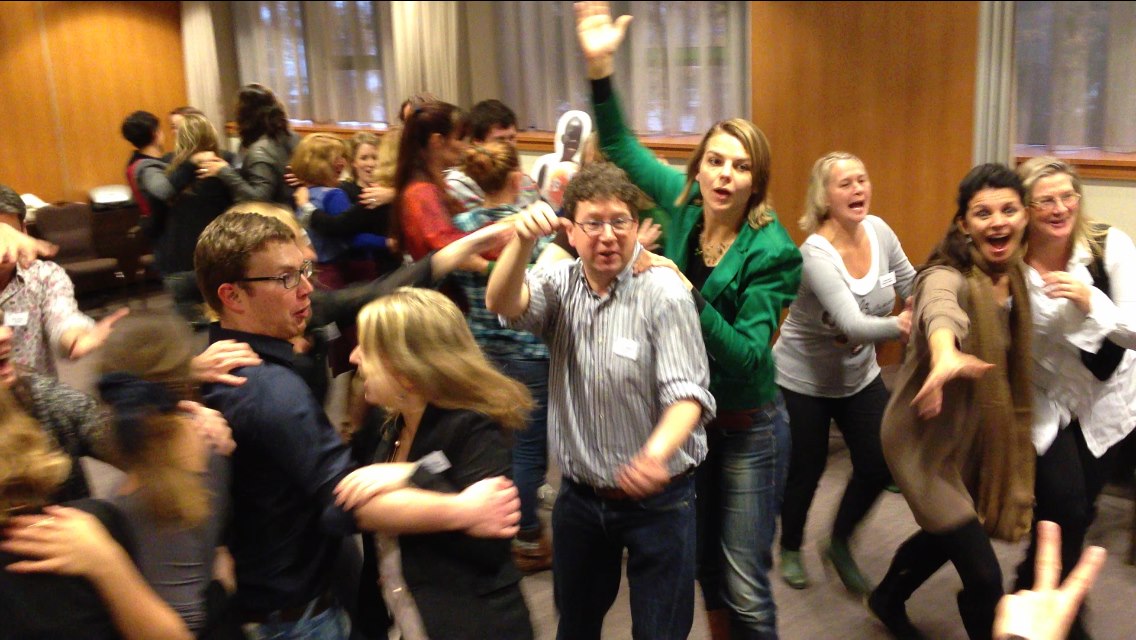
These guided experiences help participants see direct connections between improvisation and their professional contexts. In a playful, low-risk environment, participants build the confidence to explore alternative approaches, experiment with new behaviors, and test innovative solutions in a safe and supportive space. By experiencing it firsthand, clients naturally grasp why Applied Improvisation matters.

Of course, some clients connect better through case studies, others through immersive experiences, and often a combination of both is most effective. Many of us have introduced activities like One Word Story in boardrooms, transforming initial skepticism into engagement, creating openness for deeper conversations about how improvisational principles can address business challenges.
The key is to find the method that makes improvisation accessible, applicable, and engaging for the audience in front of us. Whether it’s PLAY! or another approach, our role is to make the improvisational mindset and skills feel relevant, not just entertaining.

Conclusion
As practitioners of Applied Improvisation, we don’t just talk about change - we embody it. Our goal isn’t just to explain Applied Improvisation and use a cognitive approach, but to create opportunities for people to experience it. We strive to turn concepts into actions, doubts into curiosity, and skeptics into believers.
So the next time someone asks you, “But how is this relevant to my work?” - perhaps use the PLAY! model but don’t just explain. Let’s create opportunities for them to experience the power of improvisation firsthand... let's PLAY!
About the Author: Raymond van Driel
Raymond is an international trainer, executive coach, university teacher, and keynote speaker who helps leaders and teams move from Good to Great - and enjoy the journey. A passionate improviser, previous AIN board member (2008-2018) and four-time Dutch improv champion, he brings improv into leadership and collaboration. Since 2009, he trains Applied Improvisation practitioners worldwide through his Advanced program. Raymond enjoys family time, playing piano, running (without being chased), and performing on stage with improv friends.
(Read more from our magazine issues: click here to access our article database.)
(Last Updated: Tuesday, January 13th, 2026)
|