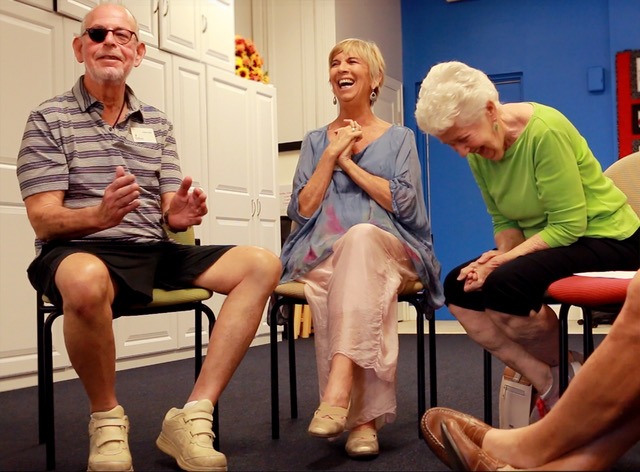
Applied Improvisation for People with Parkinson's DiseaseWritten by Margot Escott – This article is from AIM Issue 2 (released November 2023).I began teaching improv for people...With Parkinson's Disease and their care partners in 2017 at a local Parkinson’s Association and community theater. In 2020, we started teaching online and continue to meet every week via Zoom. In addition to Parkinson’s, our students have other neurological disorders and dementia. They have performed live on Facebook and are an inspirational group of people to play with. Parkinson’s Disease (PD) is a movement disorder that affects up to one million people in the US and over 40 million worldwide. PD is a complex motor disorder that can cause unintentional or uncontrollable movements. It typically occurs due to low levels of dopamine in the brain. Being intentionally playful, as we are in improv, stimulates the production of this neurotransmitter which encourages new pathways between the brain’s neurons.
Personal ConnectionsMy father had Parkinson’s Disease and passed away before I was introduced to the wonderful world of improvisational theater. I took care of him for several years before his death and attended many support groups for people with Parkinson’s and other care partners. This chronic illness has no cure. Symptoms can be reduced with medication, but it is a progressive illness. A surgery called Deep Brain Stimulation helps to control the progression. Understanding the many benefits of improv, I thought it could prove to be a powerful treatment intervention as well. My experience with improvisational theater games is primarily based on the work of Viola Spolin. Her games were developed to work with children and parents who were immigrants in Chicago, held at Hull House, the home of social work in the US. As a social worker, I feel a deep connection to Hull House and Viola, who was herself a social worker.
Curriculum with ImpactParkinson’s Disease is characterized by many problems such as facial rigidity (or masking), gait impairment characterized by shuffling, and balance issues which are the result of low dopamine levels. Behavioral health issues such as anxiety and depression are prevalent as well. Some of the improvisational exercises I teach are directly related to helping these issues. PD can be isolating not only for the individual with the disease but for the family as well. We have several care partners that participate in our weekly classes. In some cases, the person with PD is unable to navigate Zoom themselves so their partners assist them and stay in the class. Like most improv classes, we teach the Yes, and concept in our early classes. Students learn to really listen to what others say, remember it, and agree by creating an additional thought. Games like Last Word, First Word and Last Line, First Line are helpful for memory and focus. We emphasize at every class that there are no mistakes, only gifts. Students with PD, dementia, or other movement disorders, often feel embarrassed or hesitant to speak, afraid of saying the wrong word or getting confused. Often, their care partner will try to “correct” their loved one. In a gentle way, I remind all players that there is only one coach! Within the first few classes, students learn to raise their hands over their heads and say, “Ta Da!” if they think they’ve made a mistake. Playing Gibberish games can reduce their reluctance to speak or diminish their fear of mis-speaking. Gibberish also brings a lot of laughs, which addresses their mood disorders with an increase in endorphins. Also, by allowing adequate time for games, no one is pressured to speak quickly, which supports those with vocal issues. Acceptance is another important improv concept in these circumstances, as people with PD have difficulty accepting their disease. The idea that they don’t have to like it but can choose to accept the reality helps with the denial that often accompanies this disorder. This also holds true for the care partners, as they are often frustrated with the demanding schedules and role reversals (PD is more common in men).
The Magic of MusicWe start each class with music, playing Mirror and Follow the Follower. We spotlight certain players, and everyone follows their movement until the spotlight moves to another person. Movement is vital for people with PD and in this activity, students use hands, arms, and some are able to stand. This energizes students and we encourage full use of the jaw and different emotional expressions. Researchers have found that music therapy may help people with PD move faster - and make them happier. These were the results of Italian researchers that appeared in Psychosomatic Medicine. They found that music that improved patients’ abilities to move and walk can also help improve their well-being. Music is a powerful tool. We play several music games during each class. A favorite is Music Freeze Tag: when the music stops, two players hold their positions and do a short scene. This exercise also helps utilize facial muscles as well. Most of the students grew up in the 1950s and ‘60s, so I play music from those eras. Sometimes we play songs by the Beatles, like “Good Day Sunshine,” with a catchy tune and easy rhythm to follow. I encourage them to sing along, as one of the symptoms of PD is losing the ability to speak loudly. I frequently remind them to “Share your voice!” to encourage using more volume.
"Body, Mind, Intuition"After an energetic music and movement exercise, we often do a mindful exercise. I teach mindfulness, which helps students learn to be in the here and now, which is so essential for improv play. It gives them time to slow down and calm their thoughts. I use many of Viola Spolin’s games like Feel your Body. One of Spolin’s quotes speaks to the importance of this: “If you can get it out of the head and into the body...Body, Mind, and Intuition. This is what we’re after. Body, Mind, Intuition.” Another game, Show (don’t tell) your feelings, has students use their facial muscles to portray a feeling, and is part of our warm-up. After the first student “shows” an emotion, the others mirror their face and identify the feeling that is expressed. This exercise is important for students with a “PD Mask,” and reinforces the need to practice using their muscles to indicate their emotions, as opposed to the usual lack of affect. Students engage in a variety of improv exercises each week, to strengthen the muscles of their bodies and minds. Games include: One word story, Story spine, Scenes using numbers, What are you doing? Three-headed expert, I am a tree, any Gibberish game, and especially, Gibberish Opera, played with two singers and two In these classes, they have the opportunity to express themselves non-verbally through movement and music. Since speech is often difficult and slow, the non-verbal games provide a safe space to play. These activities aid in cognition and memory skills. Improvisational games present fun challenges to solve simple problems and increase self-confidence and a sense of accomplishment.
A Hopeful MissionI’ve been working with some of the same students for over eight years. Our meetings have been virtual for the past few years, allowing students from other parts of the country to join us! There is growing research on the benefits of improvisational theater for cognitive, social and emotional growth, and we look forward to more research, specifically on improv and Parkinson’s Disease. As a clinical social worker, my mission is to help people who suffer. Applied Improvisation is a wonderful tool to help people who are living with behavioral issues such as anxiety and depression, or who are coping with chronic diseases, like PD. Discovering improv has not only benefited my life but those of my patients.
References:Modugno N, Iaconelli S, Fiorelli M, Lena F, Kusch I, Mirabella G. Active theater as a Boyd, Neva. Handbook of Recreational Games, Paperback – June 1, 1975 Pacchetti, C, Mancini, F, Aglieri C, Fundaro E, Martigoni E, Nappi G. Active music therapy in Parkinson’s disease: an integrative method for motor and emotional rehabilitation. Psychosom Med. 2000 May-Jun; 62(3):386-93. doi: 10.1097/00006842-200005000-00012. Spolin, V. (1999). Improvisation for the Theater (3rd ed.). Evanston IL: Northwestern University. Stern, D. N., Sand
About the Author: Margot EscottMargot Escott, LCSW, has practiced in Naples, Florida for over 35 years. She trained as a New Games referee in the 1970s, and has taught The Healing Power of Play and Laughter workshops to corporate and healthcare workers for four decades. She discovered improv in 2011 and used Applied Improvisation in her practice. She teaches improv to people suffering mood disorders, neurological issues, dementia and those with ASD. She hosts the podcast, Improv Interviews. (Read more from our magazine issues: click here to access our article database.) (Last Updated: Tuesday, January 27th, 2026) |