Beginning, Middle, EndWritten by Benjamin Lloyd – This article is from AIM Issue 2 (released November 2023).Imagine...You are sitting on a couch. It occurs to you that your favorite beverage is in the refrigerator in the next room. You get up, go to the refrigerator and get the beverage. You return to the couch and drink it. It’s a celebratory drink you are having, as you consider the end of a year-long project today. For five years, you and your colleagues worked on a project that matters to all of you. You succeeded; the project has run its course, and today was the last day.
That project and your trip to the refrigerator share something in common, something so universal to human experience that we rarely notice it. And yet, it is an essential aspect of human learning and consciousness. Both your project and the trip to the fridge had a beginning, a middle, and an end. Beginning, middle, end (or BME in shorthand) charts a journey. From the moment we pick up and read our first story, and through all of the movies and TV we watch, and the projects we embark on, BME is as fundamental as the air we breathe. As we experience it in our lives, we internalize it and use it to organize the way we prepare for life experiences. Not only is BME a source of safety for us – a familiar arc which suggests a destination – it also describes three different kinds of experiences. Here are a few examples of experiences connected with beginnings, middles, and ends:
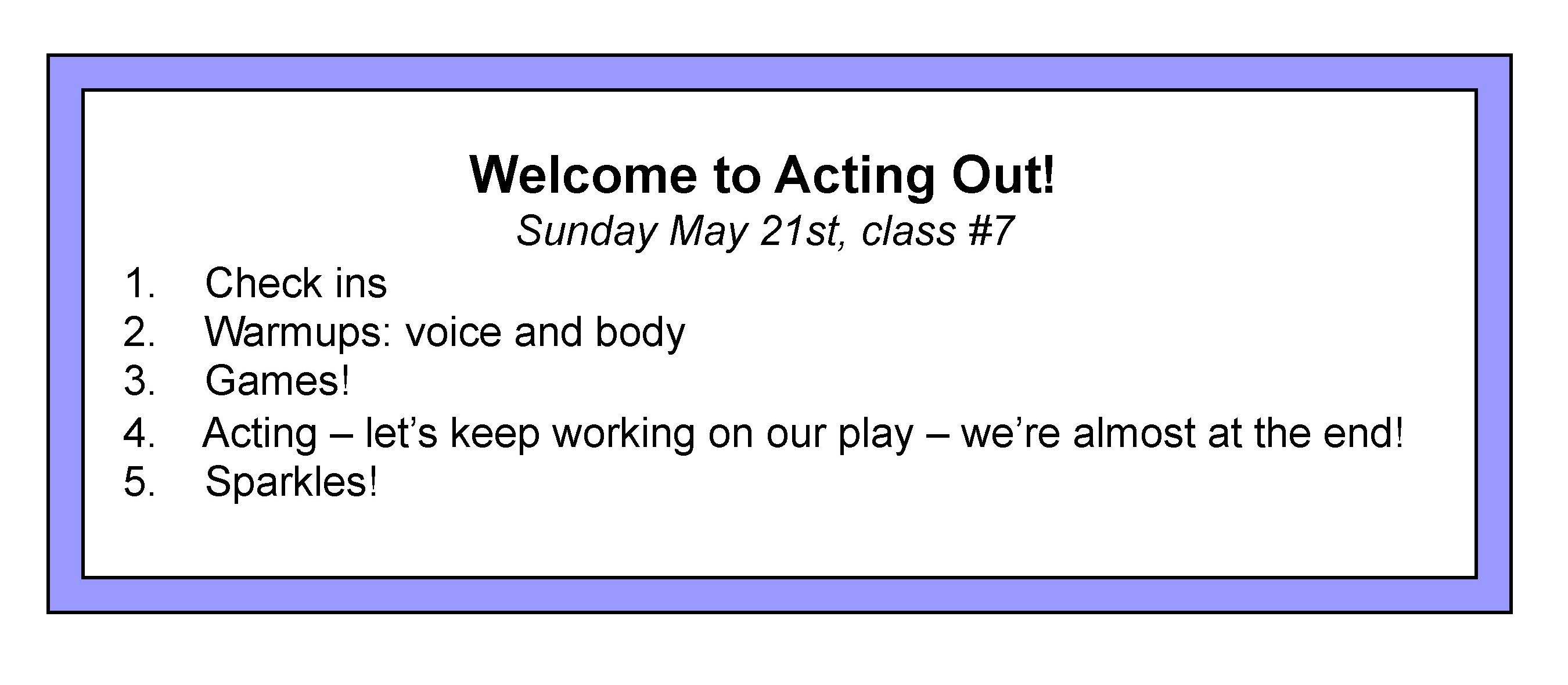
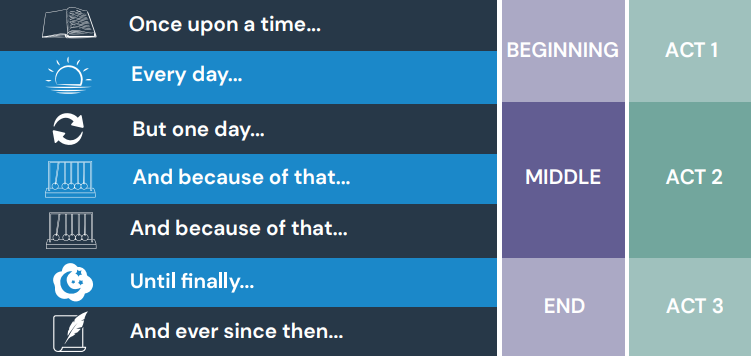
Improvisors have a unique relationship to BME. As beginners, we don’t think about it much at all – we are trying to stay present, listen to our scene partners and build a story together. Later, as we explore longform improvisation, we develop the extraordinary, bifurcated mind of the improvisor: partly immersed in the present experience, and partly hovering over the scene, looking for the map of beginning, middle, end. As an Applied Improvisation practitioner, I use BME in a variety of ways with clients. When debriefing on games or exercises I ask participants to reflect on how they felt in the beginning, in the middle and at the end. It’s a great way to link a felt experience to a learning journey: we notice that we’re nervous at the beginning, exhilarated in the middle, and accomplished at the end. A facilitator can apply that journey with the game/exercise to the larger issue at hand. "You see, friends? Maybe this merger we’re all worried about will also feel better at the end..." Sometimes with a client group I sense are open to a deeper level of artistic collaboration, I will coach participants to create three frozen tableaus: one that describes the beginning of an experience they share, one that describes the middle, and one that describes a (hoped for) end. This exercise combines creative visualization and deep collaboration with BME. Because it is so deeply connected to storytelling, BME invites creative applications. When I design scenario outlines for clients, I use the theater terms, act 1/act 2/act 3, to describe the BME journey being explored. But what if you have a condition that makes relating to BME difficult? What if you are a kind of person that is deeply rooted in the present moment, and for whom extrapolating a beginning, middle and end is a nearly impossible abstraction? I work regularly with people with a variety of diagnoses, people who have sometimes been described as having “disabilities,” although that term has recently come under scrutiny. After years of playing and creating with people with various types of neurodivergence, I have come to recognize that they are, as we all are, people with unique gifts and challenges. And some of them have a hard time grasping BME. And yet, part of my goal with these folks is to create a class in which they can experience the creative joy and accomplishment of devising, rehearsing, and performing a play using Applied Improvisation. It’s a challenge to meet each student where they are. Some students want to be in every scene. Some don’t want to be in any scene. I need to create an experience that is somehow valuable and fun for all of them. I use a whiteboard when I play with this community. Especially for people on the autism spectrum, having a visual outline of what we’re going to do in class is super helpful. An example of a class “menu”: I was looking for a way to use a visual support for developing our original plays using Beginning, Middle, End when I came across the Story Spine at the AIN Global conference in Avila, Spain last summer. Kenn Adams, Artistic Director of Synergy Theatre in the U.S.A. has popularized if not invented it. It’s an outline meant to be used to create a narrative journey. Each step is incomplete, and participants are invited to “fill in the blanks”. I have segmented the sequence into Beginning, Middle, End and added the theatrical designations, act 1, act 2, act 3.
This structure is very useful with my class of “differently-abled” people. It takes an abstraction – beginning, middle, end – and makes it visual. We put this up on a whiteboard or a big flip chart and we tell a story together. We make notes and changes as we go. We identify characters and events. And we talk about the kinds of things that happen in the beginnings of stories, in their middles, and at their ends. The goal is the fun and accomplishment of creating and performing a play together. But the life skills and experiential learning from this process are profound. People with disabilities often struggle to see themselves navigating “real life.” The obstacles they face can be overwhelming. By co-creating and then moving through a BME sequence, they practice an essential feature of being in the world: entering an experience, moving through it, and completing it. We take this sequence for granted, so much so we don’t even realize we’re doing it. The Story Spine – focusing on BME – lifts this sequence up for those who don’t take it for granted. It creates a visual roadmap, assisting people who find it difficult to both be in the moment, and think about what comes next. I described earlier, ways I refer to Beginning, Middle, End when teaching and leading games and exercises. But it has an even broader application. Imagine you are working with a group that is facing a big transition. Their company is moving, or is being bought by another company. Using a whiteboard, you might lead a brainstorm on what the beginning of this transition might look and feel like, what might happen in the middle, and how things might be at the end (good or bad!). Imagine coaching a series of vignettes bringing some of these possibilities to life – what might a group learn from witnessing each other confronting hoped-for, or fearful episodes under imaginary conditions? What behaviors and language might be identified as useful in moving towards a positive outcome? What language and behavior might be seen as contributing to a negative outcome? And maybe that’s the final point to make for now. Our hopes and fears are inextricably linked to this narrative arc we have absorbed since childhood. In our fears, we imagine ourselves ending in ruin. In our hopes, the ending is full of love and accomplishment. What a powerful tool to use in assisting people of all abilities to visualize outcomes. May your journeys have auspicious beginnings, surprising middles, and satisfying endings! I just remembered there’s something in the refrigerator I want...
About the Author: Benjamin LloydBenjamin runs bxlloyd consulting, a learning and development practice that uses the power of play and Applied Improvisation to support extraordinary teams, groups, and communities. He also continues to work creatively with people of all abilities, develop and perform in various shows, and lead classes and workshops. (Read more from our magazine issues: click here to access our article database.) (Last Updated: Tuesday, January 27th, 2026) |