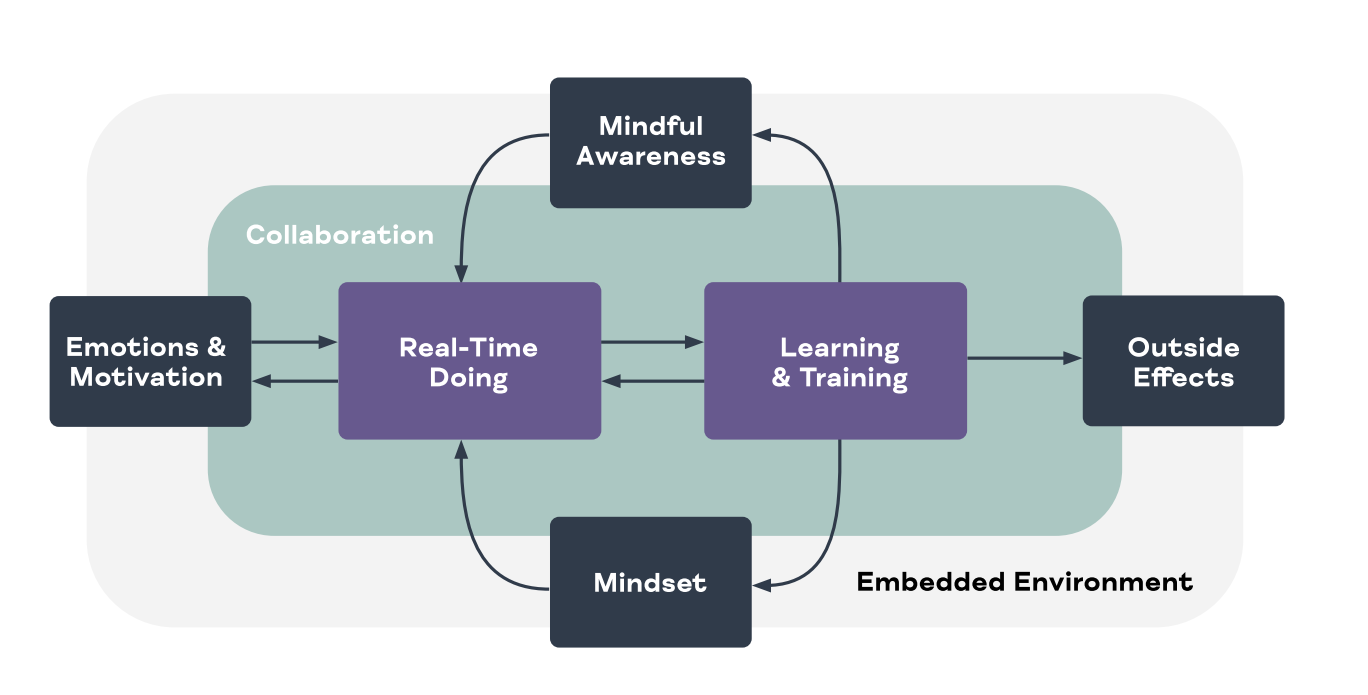
Essential Skills in Dynamic EnvironmentsWritten by Lukas Zenk – This article is from AIM Issue 1 (released December 2022). What is the fundamental difference between classical and improvised theater?At first glance, the question seems trivial. In classical theater, all scenes, actions, costumes, stage props, lighting, etc. are planned in advance and then executed. And in improvised theater they are... not planned. This leads to an interesting question: If all these resources of planning and preparation are missing, what other resources are needed to perform an improvised theater piece? We can distinguish fundamentally between planned and improvised human action. Planned actions are developed and sometimes even practiced in advance. These performed actions remain basically the same and can be repeated on demand - a routine is established. We call on improvised action either to develop something new outside a routine, or to act other than planned due to unexpected events. Thus, improvisation in current common usage means developing something new in the here and now. So, what resources do we need to improvise in theater? Basically, it requires, in addition to acting techniques and rehearsal time, special skills for collaboratively developing something new in real time. In improvisational theater, a variety of methods, techniques, and mindsets such as Yes, And-ing are trained for this purpose, to utilize the full potential offered in the moment. However, these skills are not limited to the domain of theater: they are essential in the context of dynamic environments in general. Contemporary entrepreneurs, for example, rarely develop classic business models in which they strictly follow a detailed long term plan. Instead, they iteratively develop their business models and take advantage of short term opportunities. Established organizations also increasingly face the challenge of adapting to more dynamic environments. In fact, there are myriad circumstances in which it is advantageous to not stick to an outdated plan but to remain capable of acting in real time, whether it’s project management, social work or (medical) emergencies. To investigate these fundamental improvised actions, we interviewed a wide range of experts from the arts, management, and science in a research project on Organizational Improvisation. The goal was to find out what essential skills people need when they improvise. The result was a first system model that demonstrates (similar to creativity), that improvisation is about not one single skill, but an ensemble of interacting factors. The most important factor is the ability to act effectively in real whether developing our ability to act appropriately on the theater stage or in a business project. The training develops a mindful awareness to recognize and utilize the resources currently available in the moment. Improvisers also become open to new ways of approaching challenges and dealing with setbacks. Although one can improvise alone, most experts stated that they collaborated to solve unexpected problems on the fly. A supportive environment in an organization can positively influence these improvisational episodes. In short, the study reveals that improvisation is a complex phenomenon, with skills that can be learned. In a rapidly-changing world and with the emergence of polycrises, we need such meta-competences to remain capable of taking worthwhile action. The methods and techniques of Applied Improvisation are particularly effective in building our capacity to operate off the beaten track. This does not mean we completely abandon planning: It is about recognizing when it makes sense to plan and when we need to improvise. Only then can we expect to stay calm and present as we handle challenging, complex, and dynamic situations - on stage or in a business meeting.
About the Author: Lukas ZenkLukas Zenk is an Associate Professor of Innovation and Network Research at the Department for Knowledge and Communication Management at the Danube University Krems, Austria. In his applied research projects, he investigates how people collaboratively solve complex problems and how creative and innovative processes can be supported. (Read more from our magazine issues: click here to access our article database.) (Last Updated: Tuesday, February 3rd, 2026) |