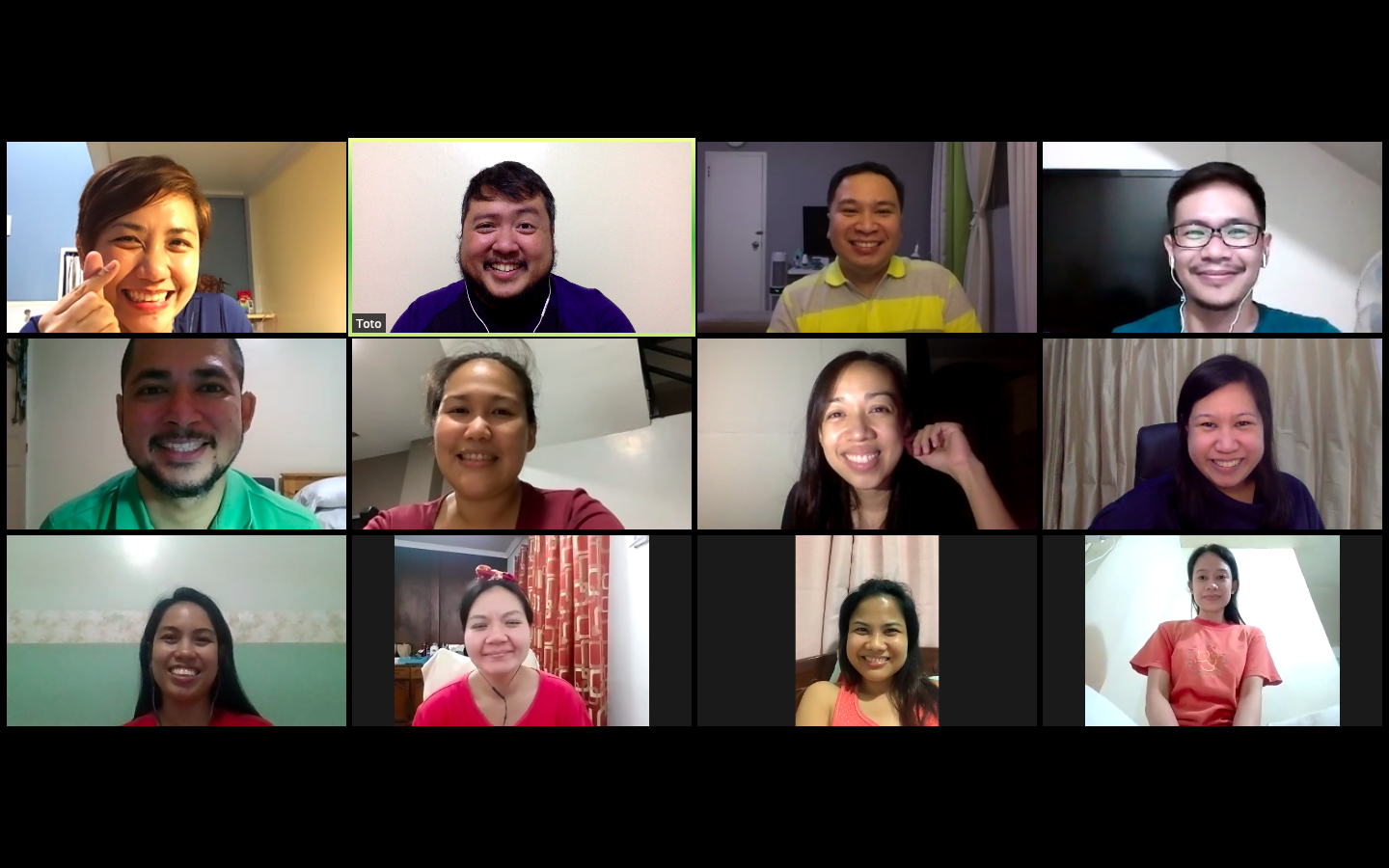
Helping Healthcare Workers via Online ImprovWritten by Anthony A Carandang – This article is from AIM Issue 2 (released November 2023). "SANDAL! Well, that was fun!"...I exclaimed after all the participants exited Zoom. It was August 2020 and we had just finished a threehour online session playing with our eight doctor friends, most of whom didn’t have any idea about improv. I thought that was it – a one-time virtual meet-up. I closed my laptop. I was wrong.
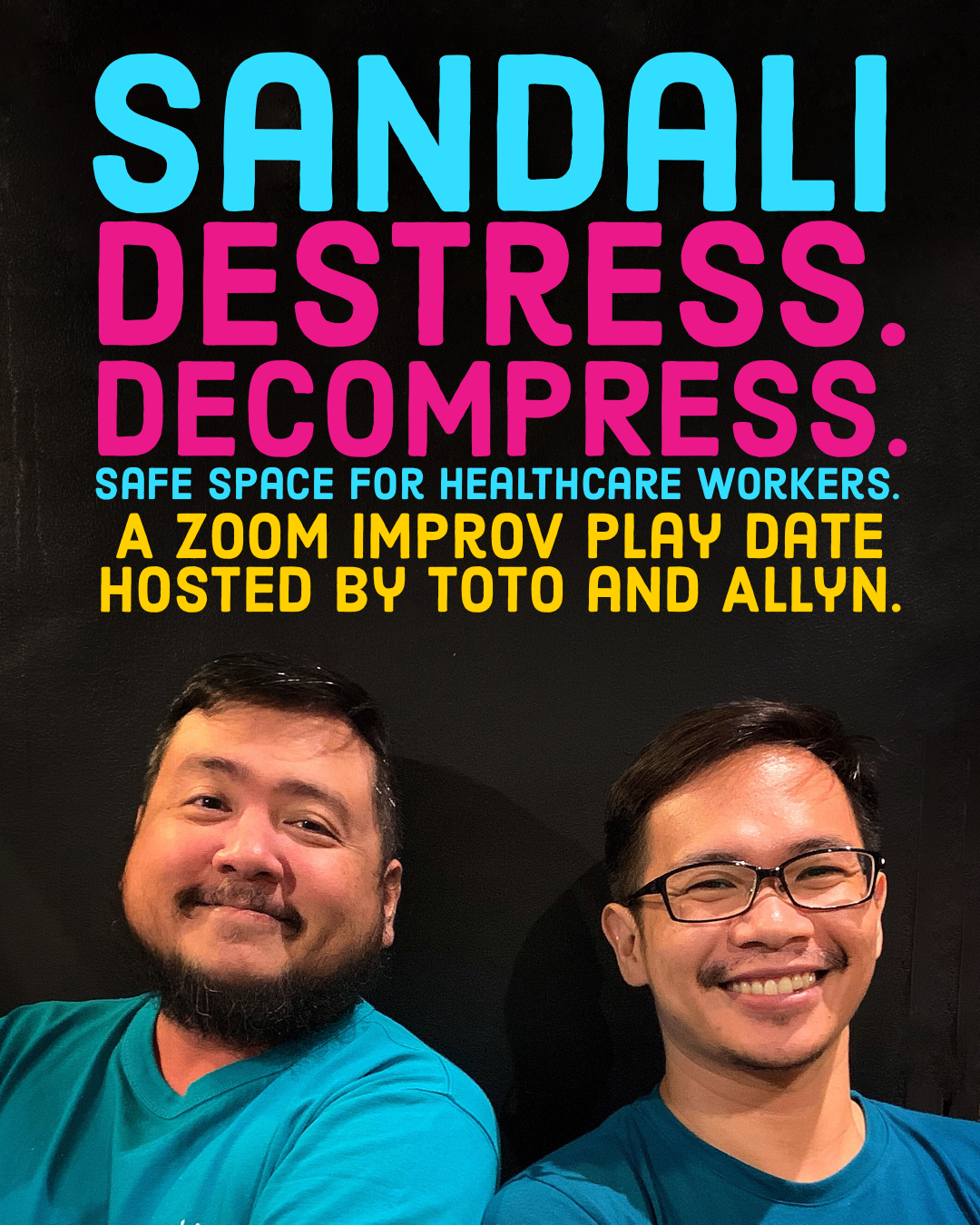
Our StorySix months into the COVID-19 pandemic, with increasingly strict lockdown protocols in Manila, Philippines, stringent quarantine and no vaccines in sight, the frustrated and tired frontline healthcare workers asked the government for a reprieve and demanded public dialogue about better strategies to stem the tide. “How else can I ‘Yes, and..’ one of the greatest challenges facing our generation? What could I do for my friends to help them destress even for a little bit?” This thought led me to partner with Allyn Lomboy, a fellow physician-improviser. We invited our friends in the medical field and eight responded. The original plan was to do an hour of improv games on Zoom that would entail talking, playing and debriefs. And that’s where we got the name of our dynamic duo, PlayMD. I decided to aptly call our session SANDALI, a word derived from the Old Tagalog phrase isang dali, which literally means one plus a measurement unit based on a finger’s width – or about an inch (Noceda, 1754). SANDALI connotes an instant; a brief moment; or a command to stop and pause. Two weeks after our first SANDALI session, I found myself going back to my laptop. We had our second group composed of OBGYNs. Soon after, our friends started recommending us to their peers and residents, and Allyn and I started offering sessions that tackled resilience strategies, team collaboration, and forming connections. By late October 2022, we had conducted 60 Zoom sessions with over 520 participants from different departments in several hospitals throughout the country.
ZOOM: Playing Separately but TogetherThe pandemic forced healthcare institutions to migrate virtually. Several studies (see references) documented the success and challenges of medical schools and training institutions adapting their classes, learning modules, and conferences to an online format. Zoom became their medium of choice. I knew that we could do the same. Even though most of the doctors were already adept with Zoom, some challenges remained, such as disappearing audio, loud background noises, frozen faces and even interrupted connections. Online facilitation tested our patience and ‘Yes, and…’ capabilities. One time, Allyn’s internet and laptop both consecutively died so he had to come over to my place. We continued that session sharing a laptop, compressing ourselves to fit one tiny Zoom square! The unpredictability of medical work was also an issue. Some sessions saw several participants on active hospital duty and a few were called away to attend to patients, never to rejoin the group. Some joined using their mobile phones while driving home. One doctor stayed inside her car in the parking lot for almost three hours. Another used her tablet in the Out Patient Department as it was being closed.
Our ExperienceMost of our curious participants had no idea about improvisation and joined SANDALI with pervading nervousness or anxiety. But these soon faded away after our warm-up exercises. It was beautiful to see analytically inclined and left-brained professionals jump into the unknown, embrace uncertainty, and play without judgment or fear. “I never thought I needed this,” a doctor remarked. The game that resonated the most with the doctors was Fortunately/Unfortunately where the group created a coherent story with each member contributing one sentence at a time. Each alternating sentence had to either start with the word “Fortunately…” or “Unfortunately…”. This exercise taught them to actively listen, accept each other’s offers, connect ideas together, relinquish control, think of creative ways around roadblocks, and collaborate as a group. One beautiful memory I have was the first time we played Turn Your Camera On. It began with everyone’s cameras turned off. Somebody would say, “turn your camera on if…” followed by a truth about themselves like, “you love coffee.” Participants briefly turned their cameras on for a few seconds if they shared that truth. Then another round. Playing this exercise, some residents became teary-eyed and even cried. They haven’t felt this connected since before the pandemic began. It was as if this huge, heavy load was lifted, knowing they were not alone. A good way to start forming connections is finding commonalities between people. Two other games also resonated well: One Word Story and 3-Line Scene. Additionally, Pass the Face was a simple game that was surprisingly a hit, allowing doctors who deal with life and death situations to let go, laugh out loud and just be silly. Mirroring exercises were less favorably received but when we asked the group to follow one leader and made it into a guessing game, then people gleefully committed to it. It is heartwarming to witness participants discover the magic of improv and arrive at similar revelations about themselves and others.
Some of the realizations during SANDALI include:
Andrea et al’s study (2020), which involved 40-minute Zoom sessions between medical students and COVID-19 frontline physicians, concluded that one of their program’s benefits is an increased sense of connectedness. I observed this similar phenomenon in multiple sessions across different participating groups. Initially, we thought that we were working towards obsolescence - that the pandemic would end after a few months and our services would not be needed. We were wrong. The pandemic dragged on. The virus changed and adapted. So did we.
So What's Next?PlayMD has started conducting face-to-face team building sessions with cross-functional healthcare teams. Topics include presentation skills for residents, resilience strategies, active listening and status play for empathic communication. Early in 2023, I led a two-day storytelling workshop for the University of the Philippines Diliman biologists. We also partnered with the Department of Medicine of the University of the Philippines-Philippine General Hospital for monthly improv sessions with their residents. One of our ultimate goals is to advocate for improvisation and its incorporation into the Philippine medical curriculum as an ancillary tool. To date, we still offer online sessions. I don’t think people will give up Zoom any time soon. Online or a hybrid approach is here to stay. Looking back, I always knew that the lessons I learned in my improv classes could be used to help people in their everyday lives. Improv changed me and it has the potential to change the lives of others. As improvisers, this is our power - to sit and be comfortable with being uncomfortable. To jump into the unknown. The global pandemic, with all its frightful changes and seemingly impossible difficulties, has beckoned for one big “Yes, and...”. There is no better time to answer that call. Back in 2020, Allyn said, “You know, things can happen and all this can be over in a few months.” It was half a year into the COVID-19 pandemic and we had just finished our nth SANDALI session. “Yes, we’ll carry on until whenever,” I replied. I closed my laptop. “Our goal is obsolescence,” he added. It wasn’t as if we wanted to stop. He just meant he wanted things to improve so that online sessions like SANDALI would not be needed anymore. We both wished we could go back to our regular lives and that life would go back to the way things were. But life, like an improv scene, took an unexpected turn. “Yes,” I replied. “And…” The (next) offer awaits.
ReferencesAnderi, E., Sherman, L., Saymuah, S., Ayers, E., & Kromrei, H. T. (2020). Learning communities engage medical students: a COVID-19 virtual conversation series. Cureus, 12(8). Camargo, C. P., Tempski, P. Z., Busnardo, F. F., Martins, M. D. A., & Gemperli, R. (2020). Online learning and COVID-19: a meta-synthesis analysis. Clinics, 75. Carandang, A. A. & Lomboy, A. R. B. ((2020). PlayMD’s SANDALI: Online improvisation with Philippine healthcare workers during the COVID-19 pandemic. Diliman Review DÁNAS/[R]ÁNAS, 64(1), 78-100. Noceda, Juan de. (1754). Vocabulario de la lengua tagala trabajado por varios sujetos doctos y graves, y últimamente añadido, corregido y coordinado por el P. Juan de Noceda y el P. Pedro de San Lucar de la Compañía de Jesús. Manila: Nicolás de la Cruz Bargay. Patel, S. M., Miller, C. R., Schiavi, A., Toy, S., & Schwengel, D. A. (2020). The sim must go on: adapting resident education to the COVID-19 pandemic using must go on: adapting resident education to the COVID-19 pandemic using telesimulation. Advances in Simulation, 5(1), 1-11. telesimulation. Advances in Simulation, 5(1), 1-11. Sindiani, A. M., Obeidat, N., Alshdaifat, E., Elsalem, L., Alwani, M. M., Rawashdeh, H., Fares, A. S., Alalawne, T., & Tawalbeh, L. I. (2020). Distance education during the COVID-19 outbreak: A cross-sectional study among medical students in North of Jordan. Annals of Medicine and Surgery, 59, 186-194.
About the Author: Anthony A CarandangAnthony is a physician with Radiology training, based in Manila, Philippines. He is the co-founder and lead facilitator of PlayMD, a Medical Improvisation group that supports collaborative and communicative pathways to improve doctors’ well-being and achieve better patient outcomes. He is known as “Toto” in his beloved improv community. He is also interested in empathy and storytelling for science communication. (Read more from our magazine issues: click here to access our article database.) (Last Updated: Wednesday, January 28th, 2026) |