Increase Empathy & Mindfulness with Improvisation in Undergraduate EducationWritten by Diana DePasquale – This article is from AIM Issue 2 (released November 2023). I was assigned to teach Critical Thinking About Great Ideas during the spring 2021 semester.I decided to build the course around the foundational principles of long form improvisation to give students opportunities to use improvisation in their daily lives and help them communicate more effectively, be more open to others, and develop their empathy and creativity. Although I taught at the university level for a decade and I am one of the founders of Glass City Improv in Toledo, Ohio, I had never designed a course this way. During the pandemic, I offered free Zoom classes for people looking for ways to feel more connected to, and present with others through mutual support and affirmation using improv games and exercises. I also teach Applied Improvisation to organizations across northwest Ohio. I show leaders how to use the foundational principles of improvisation to promote creativity and collaboration, mutual agreement and acceptance of ideas, and the development of trust, confidence, and cohesion among their teams. I was inspired in part by reading Don Waisanen’s Improv for Democracy (State University of New York, 2020). Waisanen’s text strongly suggests improv based teaching and training methods can bridge differences and promote communication, leadership, and civil skills. Using this text as our anchor, our community of thoughtful learners explored how empathy is developed and strengthened across coalitions, and how we can find innovative solutions to complex problems through enthusiastic collaboration. Assignments were developed around identification of personal values and how they align with the choices we make every day, how to live a life with purpose and meaning, and development of communication skills and perspective-taking through storytelling. I also built in opportunities for cooperative play with BaFa’ BaFa’ and Where Do You Draw the Line?, two board games dependent on spontaneity and cooperative game play. One of the greatest things I’ve learned from improv is how to relinquish the fear of failure and develop my resilience. All the assignments were posted on our classroom management learning system in a discussion thread for each week. In one writing prompt I asked students to reflect on their failures and successes. In particular, instances when they took bold risks and what they learned from the experience. In other words, I wanted students to think about the skills and techniques they’d need to use in their role as a student leader on campus or in their future career or vocation, or even as a friend, spouse, or caretaker. It was a goal of mine to remind my students it can be easy to feel alone when things don’t work out as planned but improvisation can give us the skills to adapt and pivot when the unexpected happens.
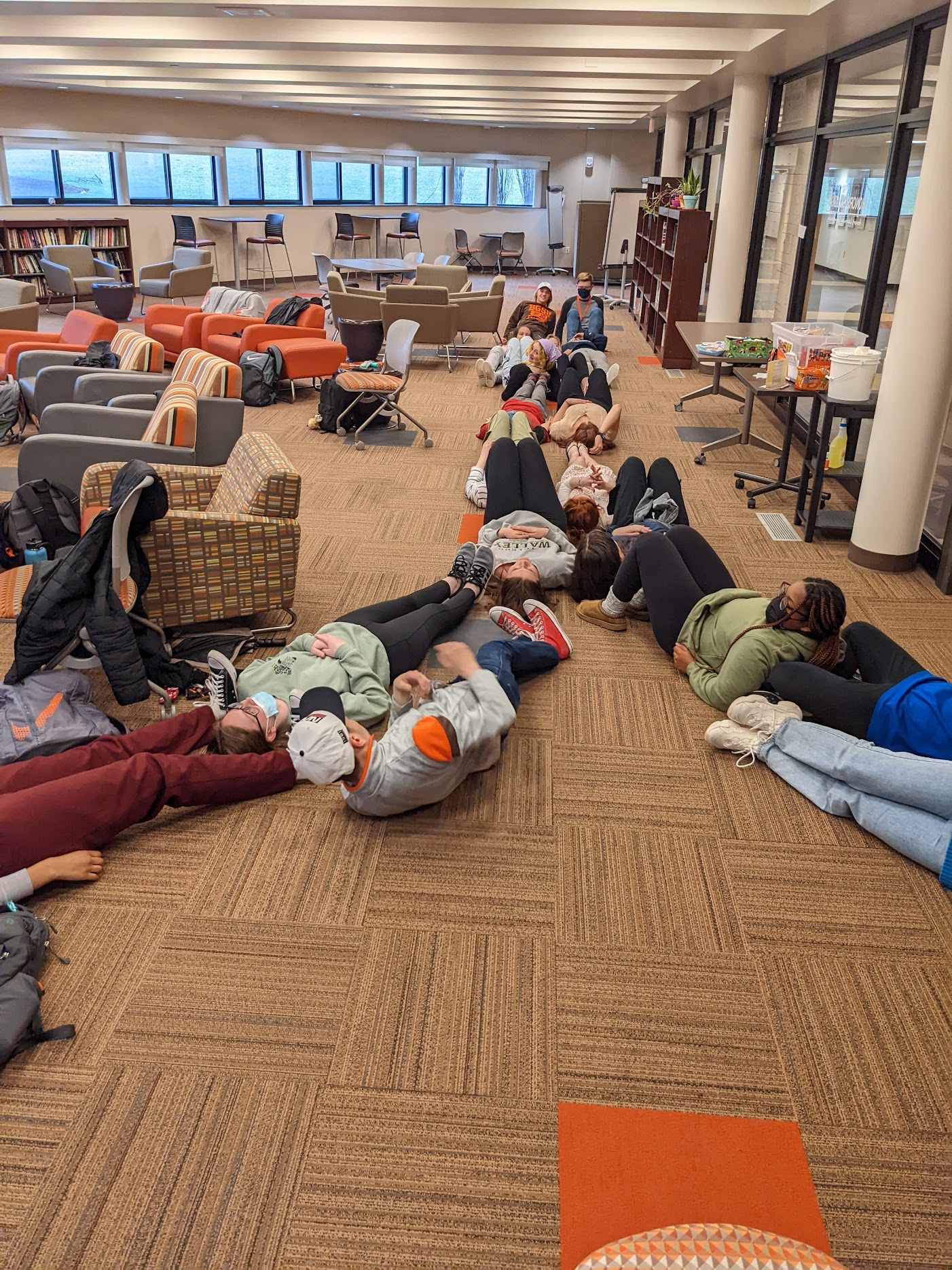
Students were not aware until a few days before class that the class would be centered around improvisation. On the first day of class many students revealed their fear of failing at not getting it “right” and a few didn’t want to engage. An overwhelming majority of my students also revealed their struggles with anxiety and depression either in class or in emails to me. Taking both of these into consideration, I knew I had an opportunity to give students techniques to accept and support each other, and affirm their partners’ choices through active listening and agreement. We played lots of games in class, but what follows are the ones that made the most impact. Once we started playing Zip Zap Zop everyone became engaged! I built in the rule that if a player messes up we all shout, “Hurray!” at the top of our lungs. While faculty teaching nearby may not have appreciated this, my students absolutely did. Zip Zap Zop is irresistible to use for beginners because of its ease and likability, but I also explain to students that Zip Zap Zop is all about being in the moment. You can’t “catch” a Zip from someone if you’re in your head thinking about something you regret from the past or planning for a future mistake you’re sure you’ll make. Staying alert and paying attention to the members of the group is what makes Zip Zap Zop so immediately fun! And when anyone makes a mistake, we celebrate it, and move on with the game. No one is made to feel like they failed at their task. Another game which requires active listening is One-word Story, and as we formed our 22-person circle, I didn’t explain much. I just told everyone to add a word of their own without thinking about it too long. My goal was to encourage spontaneity and diminish harsh judgment of their own contributions to the story. Once again, the circle came alive quickly and our stories went several rounds before reaching their end. Quite often we knew the story was over when we were laughing so hard it became hard to hear each other. I also made sure to include games that required silent cooperation among students. The Line Up Game is perfect for this. I explain they need to line up in order of birth date without speaking to each other, giving them only a few minutes to assemble. Giving them the go-ahead, I watched students using their fingers and hands to establish months and days, and then walk closer to, or farther away from each other. Some students approach it seriously, some are laughing, but everyone is involved, either in the silent consideration of the data, or in the moving back and forth between players. At first glance, requiring silence makes it more difficult, but it asks them to use different skills in communication that are a delight to see in action! I watched them use facial expressions to indicate agreement, and hand signals to represent days or months. Some students would take the information and run to the front, back or middle of the line and begin the process with a new group in a new location relative to their birthday. I have students use this as an opportunity to become aware of themselves in relation to others and how to find their connection to each other. Finally, the game I used in the classroom that I found most useful for my students and myself is called Change in Motion and works well with a big group for reasons that should become obvious. I begin by asking students to walk around in no particular direction or path. In fact, it’s best to wander here and there amongst each other. I explain that there are only two things to do: walk and stop. They begin walking when I call, “Walk!” and stop walking when I call, “Stop!” After we do that for several successful rounds, I explain that we’re going to flip it; when I say “walk” they should stop walking and when I say “stop” they should walk. It’s clumsy the first time, but they quickly get in-tune. I then add two new words: “name” and “jump.” As you might guess, when I say “name” they shout their first name and when I say “jump” they hop in place. As we did before, after a few rounds we switch up to jumping when I say “name” and saying their name when I say “jump.” We’ve now got four words to listen for: jump, name, walk and stop. I add more words - clap and twist - and we continue as before, eventually switching clap for twist and vice versa. Students laugh even when they get it wrong and that’s the point. In order for students to feel comfortable with risk, they need a safety net and that’s what my class provided. For me, teaching this class helped me create a bridge between my work as an improviser and an educator. This was something I was hesitant to try for a long while, but the results could not be denied. The feedback for this class was far and away the most positive I’ve ever received in my decade of teaching. The overwhelming majority of students offered that they had learned to be more spontaneous and comfortable in their skin, felt more meaningfully connected to their peers, and gained confidence and self-assuredness. I would encourage anyone involved in teaching to bring improvisation into your classroom. It creates such a strong sense of community for your students, and regardless of the subject matter, you get to share the power of Applied Improvisation.
About the Author: Diana DePasqualeDiana DePasquale trained and performed in New York City at the Upright Citizens Brigade, Peoples Improv Theater, and Magnet Theater. Diana performed in the Chicago Improv Festival, Del Close Marathon, and Kalamazoo Improv Festival. In 2018 she co-founded Glass City Improv in Toledo, Ohio where she taught college courses on American culture and identity. Her scholarship on improvisation has been published in Studies in American Humor and on the Society for Cinema and Media Studies’ podcast, Aca-Media. (Read more from our magazine issues: click here to access our article database.) (From our AI in Education Track) (Last Updated: Wednesday, January 28th, 2026) |