Reimagining a Collaborative Final ExamWritten by Caitlin McClure – This article is from AIM Issue 2 (released November 2023). “Final Exam?! But this is a course on leadership and improv,” my students gasped.For the past two years, I have taught Leading Creative Collaboration, a required course within the Executive MBA program at Stevens Institute of Technology in New Jersey, in the U.S. In 2022, I challenged myself to add a final exam that would be true to the spirit of the course while still avoiding the drawbacks of traditional exams that are usually stressful solo endeavors and may not indicate actual competency. In addition to being guided by improv principles, such as be average and give and take, I frequently rely on a fundamental lesson from Keith Johnstone: clearly identify the problem to be solved, then create a tool/process to solve it. So, I defined my problem like this: What kind of final exam will function as a capstone experience for the students, will reinforce the principles of collaboration, and will uncover the ways the students had developed?
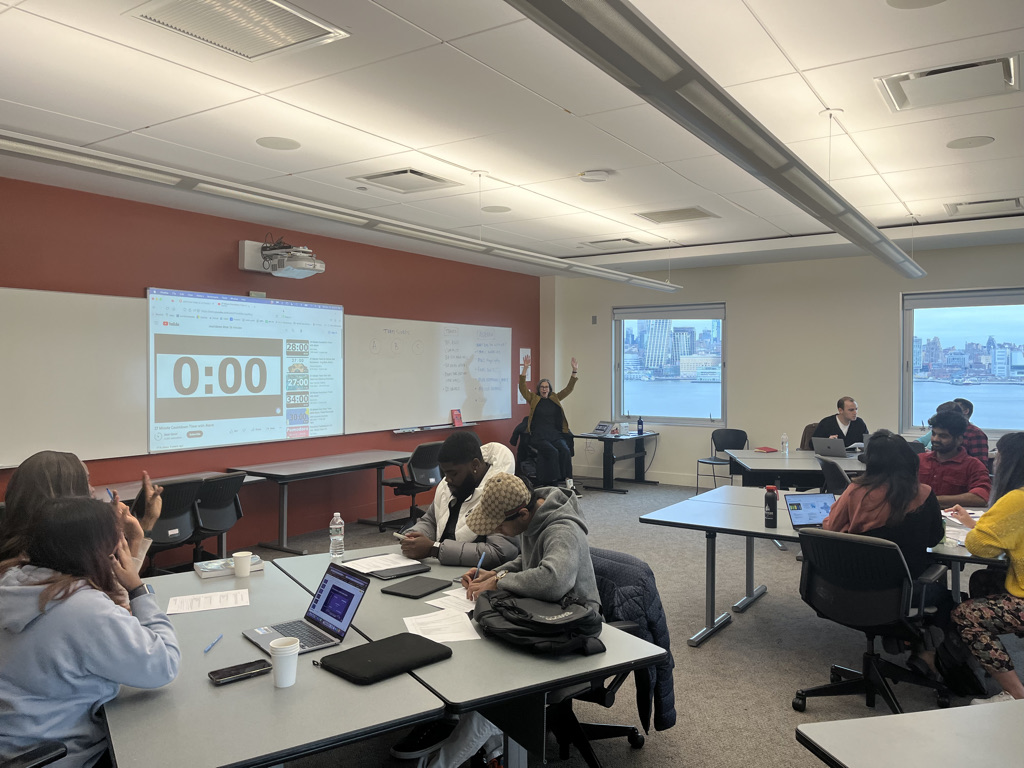
As a solution, I created 12 questions on the exam—to cover topics that I felt were vital to their understanding of the material– then I asked the students to provide the other 12. My intention was a) to reinforce their sense of being an ensemble, capable of supporting each other’s learning, b) to reframe a final exam as something more than transactional, and c) to create a frisson of excitement about what their peers might ask of them. Here are two sample questions from me: “According to Stuart Brown, work is the opposite of play. True or False?” “Why does the theory of Organizational Climate (as opposed to Organizational Culture) matter to leaders?” Here are two questions from students: “Describe a time where you used an improv tenet to deal with a difficult conversation.” “Which of the following is not an improv principle? a) Be obvious, b) Leap before you look, c) Sympathize with your partner, d) Give and take.” Our classes were held in-person with the 11 students divided into three teams. Seated with their teams, I set up the final exam:
I handed out the exam paper, started a countdown clock and said, “Go!” When they first looked at the questions, they were sweating and serious. It was 10 points out of their grade of 100. They were relieved as I reminded them the exam was graded collectively. They spent the first few minutes reviewing the questions, then deciding who would answer each one. Except for the shuffle of papers and the sound of clicking keyboards, the room was silent, punctuated by the occasional voices, “Oh, let me do question four!” or “Sal, you could share that story about your roommate for question 12.” Half an hour later, laptops down, they were ready. I asked each team to tell me their answer to Question One. Then I shared the “correct” answer and distributed their points accordingly, tallied on a whiteboard. We continued like this for all 24 questions, which took about 40 minutes to complete. Hooray, what a final exam! I really wasn’t sure how the grading part was going to work out, but it turned into a delightful free-for-all; a fullclass conversation and discovery process. One big discovery is the degree to which they supported each other, big time! They gave the simpler questions to their teammates who had struggled the most during the semester. Those students could have simply stayed quiet, but everyone was given at least one chance to speak and was encouraged by their team to answer confidently, with cheers and approval once they earned their point.
That indicated to me that they were showing up true to what Leonard and Yorton say in their book, Yes, And (2015, p.71): “…your ensemble is only as good as its ability to compensate for its weakest member.” One team asked to change their answer after hearing another team’s response. I couldn’t think of a reason to say no as the whole idea was to work collaboratively. At other times, they made compelling arguments for why I should accept their answer even if I initially indicated that it didn’t quite hit the mark. It became a fully collaborative process with students arguing on behalf of their peers, even for other teams. I did not indicate beforehand how the exam would be graded, but hinted the process mattered more than the answers. Since they got most of the answers correct, I gave everyone all ten points. It was clear from their full commitment to the exam and to each other that the experience itself was more important than the actual answers. Why is this Applied Improvisation? We didn’t play then debrief any improv games! An exam like this could only have come from an Applied Improvisation mindset, rather than a traditional, hierarchical, right/wrong approach to pedagogy. I felt validated when I later realized that our exam hit all of the Top 10 Elements of AI, as identified in the 2014 Delphi Study Summary by Barbara Tint and Adam Froerer:
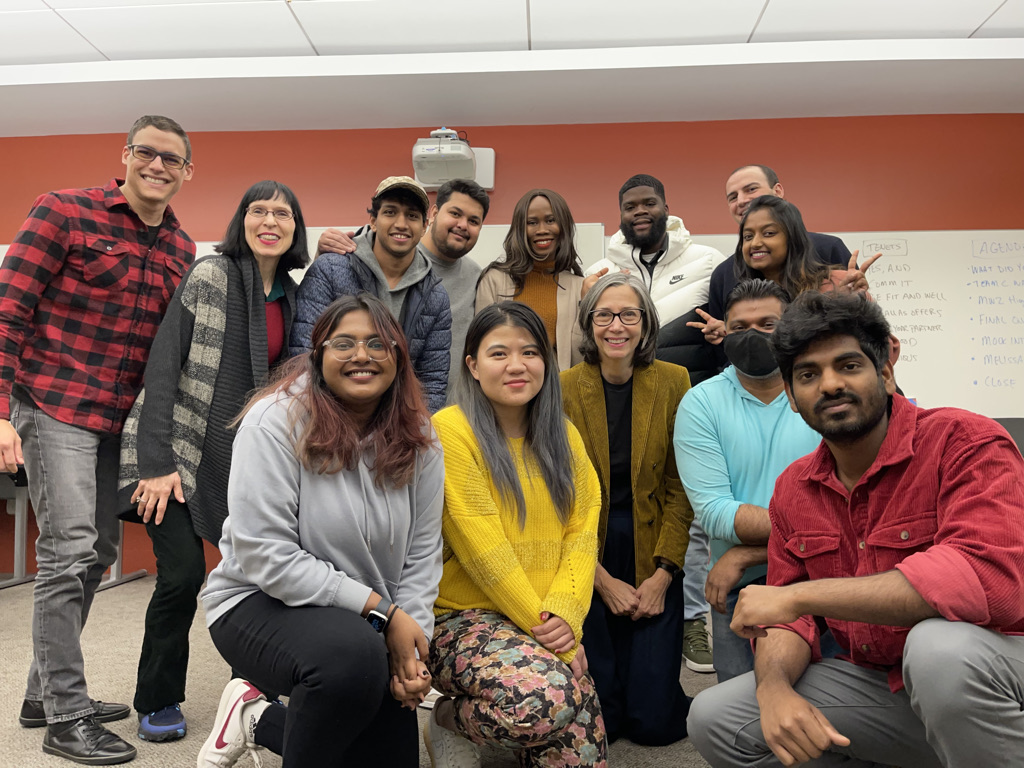
After the exam, one of the less strong students said to me, “I had been worried about the test, and now I am thrilled I actually helped my team be victorious.” Then one of my strongest students shook my hand, looked me in the eye, and said, “Caitlin, Thank You!” I asked, “for what?” She continued, “For years I wanted to challenge the status quo at work but felt daunted to try. The experience today proved I can reinvent how work gets done.” Yes, I was high as a kite. Not only had the experiment worked, I stumbled upon a new process I could use again in the future. Ultimately, my students had had an experience of challenging and supporting each other to learn, the experience reinforced what we had been practicing all semester in real time, and we collectively and collaboratively finished up the course true to its intent. Long live Applied Improvisation!
About the Author: Caitlin McClureCaitlin McClure is a leadership development consultant, executive coach, professor in the business schools of Stevens Institute of Technology and Baruch College, and co-editor of two books of case studies, Applied Improvisation: Leading, Collaborating & Creating Beyond the Theatre and The Applied Improvisation Mindset. Her MA is in Adult Learning and Leadership from Columbia University. She lives in New Rochelle, New York. (Read more from our magazine issues: click here to access our article database.) (From our AI in Education Track) (Last Updated: Thursday, January 29th, 2026) |