The AI Bookshelf is Developing Nicely – and there's room for a whole lot more!Written by Paul Z Jackson – This article is from AIM Issue 2 (released November 2023). There are many books about improvisation, mostly about theatrical improv.And now the bookshelf for Applied Improvisation (AI) is expanding rapidly, probably at a rate making it increasingly unlikely for anyone to be able to read everything. What is this bookshelf? First and non-metaphorically, I have dozens of printed books accumulated to accompany my first purchase on the topic, Keith Johnstone’s Impro. Then there are fan lists curated by our colleagues such as this Goodreads page from Bright Su. And Theodore Klein’s collection. Going beyond books to other media resources, you could dip into this handy guide, also from our esteemed editor, Bright Su. Today’s article is based on a more modest trawl of my Kindle collection, searching for titular keywords such as ‘Improv,’ ‘Presence’ and ‘Yes.’ This turned up 35 entries, about half of which I’d purchased, with the remainder free samples. I’ve dipped into all of them and read several. I must confess that they tend to blur into each other after a while. If we eliminate those purely about improv as performance and focus on applications of improvisation, here are my notes on apparent trends and observations on a few of the most interesting. Overall, it seems we are getting the kinds of titles we’d hope for on a bookshelf about AI, such as applications in particular contexts such as schools, creative organizations or medical practice. What’s disappointing is that the contents too often fall short of a theory, a thought-through approach to getting beyond the stage, or even a perspective regarding improvisation for life or work. They tend to make a case in favour of applying improvisation – well, OK, but I’m persuaded anyway – and offer a long list of activities with which any theatrical improviser will already be familiar.
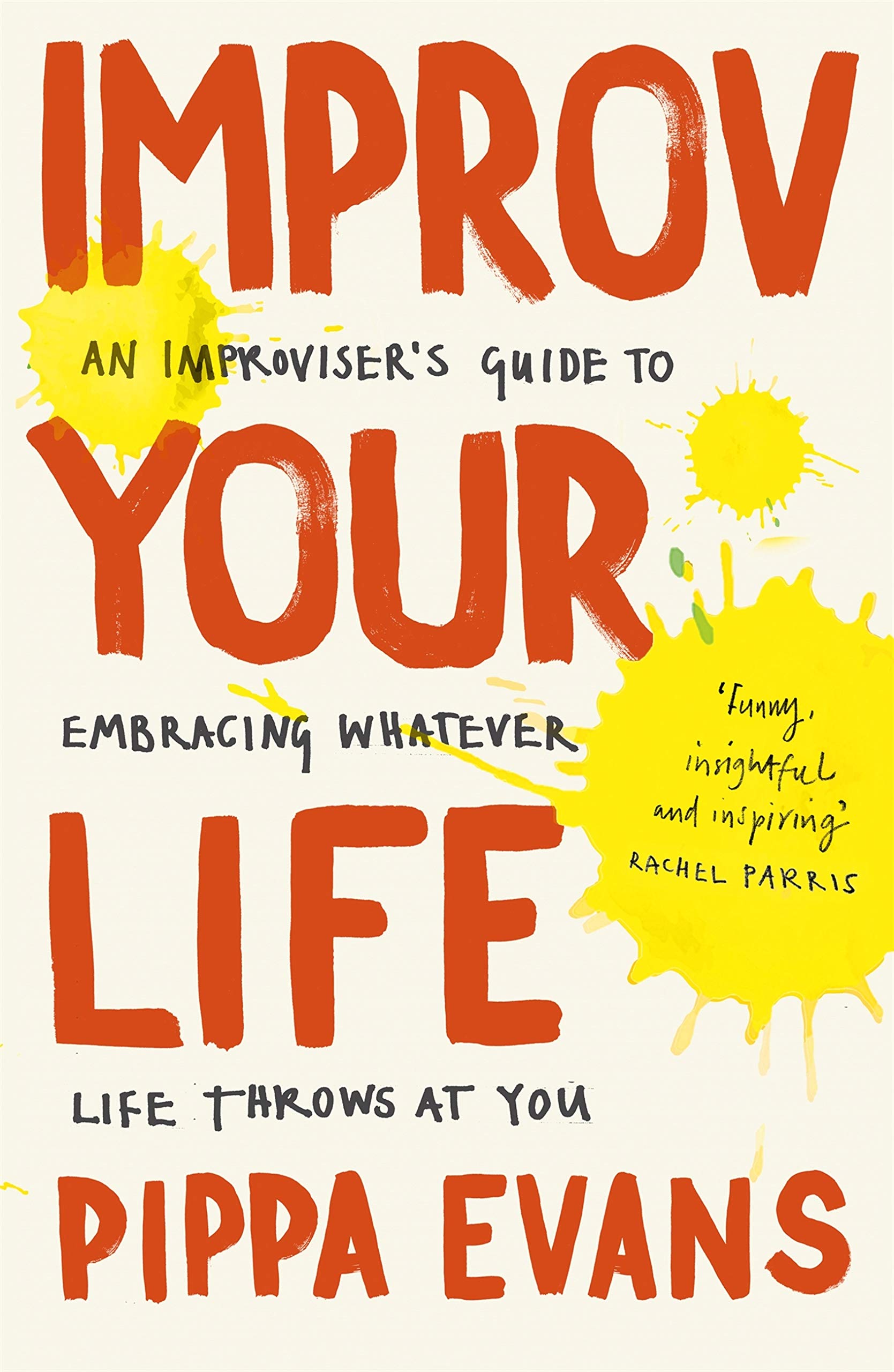
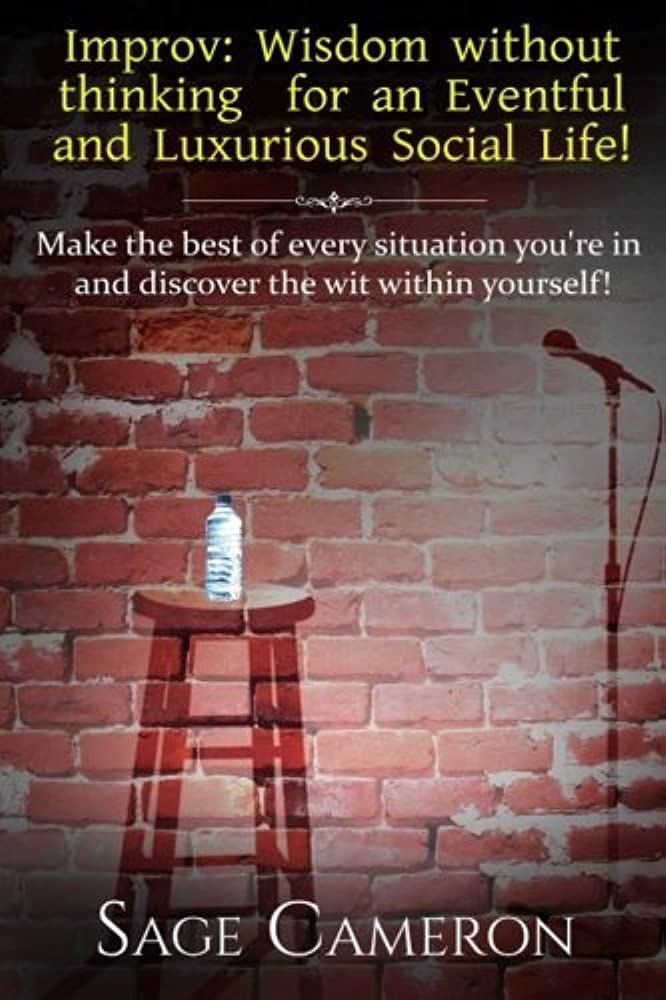
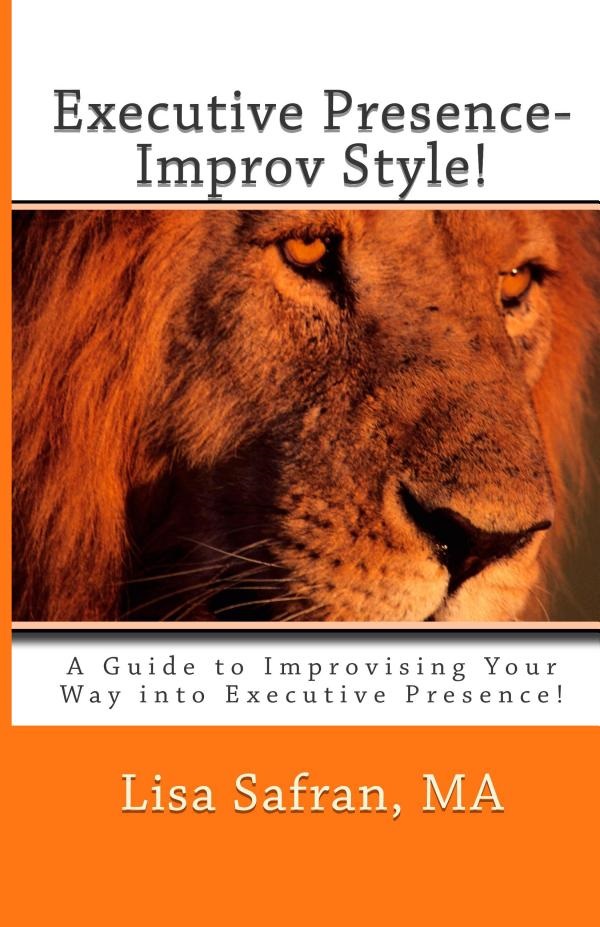
Among the titles presenting attractive topics are Improv Your Life (2021) by British performer and social activist Pippa Evans; Executive Presence – Improv Style! (2013) by long-time West Coast AIN-er Lisa Safran; and Seattle based Sage Cameron’s Improv: Wisdom Without Thinking for an Eventful and Luxurious Social Life! (2016).
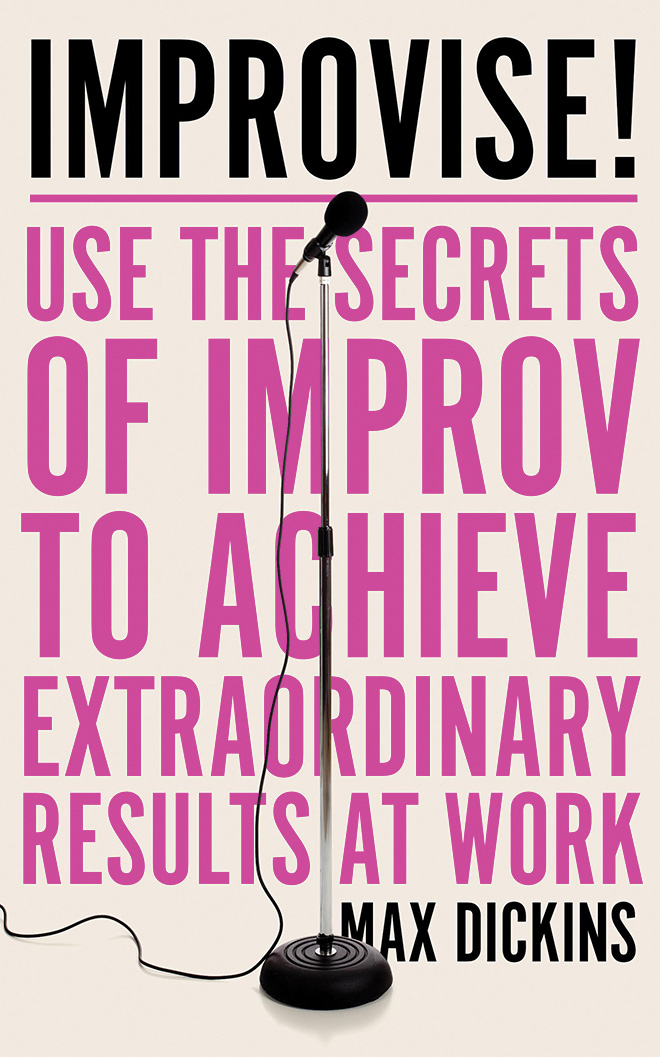
I swiftly warmed to Cameron when I read the section distinguishing performance improv from Applied Improvisation: “Although improv is mostly popular as a form of theatrical approach, its concepts and disciplines have been used in a lot of non-theater industries and practices, generally called Applied Improvisation. Improvisation Outside of the Stage. Although improvisation relies heavily on being spontaneous and being ‘in the moment,’ there are a set of principles and skills that improvisers follow to create an effective ‘improvised’ show. These same set of principles are now being utilized and applied in different fields to encourage spontaneity and adaptability. According to Paul Z Jackson, President of the Applied Improvisation Network, ‘applying the concepts of improvisation in organizations can help in improving leadership, management, communication, teamwork, and cooperation. It is a useful tool in adapting to change and complexity and it brings out better results as it boosts an individual’s courage, energy, and creativity. Improvisation concepts help in developing a person’s confidence to face complex scenarios by being aware of their own self and their own surroundings, trusting their intuition and creativity, thinking outside the box, and responding on the drop of a dime.’” Great to be quoted, though I wonder if there’s yet an agreed set of principles or a theory of change that pertains offstage and on. He continues, “This is helpful in today’s modern and fast-paced world where people are expected to be flexible and responsive to any given situation! Numerous companies are now applying the concepts and disciplines of improvisation in running their organizations. These disciplines train leaders and managers on how to efficiently manage a group and maximize their potential. Results have shown that applied improvisation teaches authentic communication, creative negotiation, empathy, quick thinking, and camaraderie. With these, a wider range of options and possibilities are discovered without going all over the place. The growth in a company or individual will be exponential as a direct result of using Improvisational concepts!” Nicely put, and though the bulk of the book is quite simple and beginner-ish, it’s well organized and highlights a crucial difference between guidance for stage improv and wisdom for life: “As a common improv adage when it comes to raising the stakes goes: ‘Don’t solve the problem, live in it!’” That makes for good drama, whereas in life we’d rather solve the problem as easily as possible, so we can get on with things – so of course the precepts for good improvised drama will not carry over directly as precepts for real-life applications. Max Dickins, from London’s Hoopla stable, has also made a stretch into adding something new in Improvise! (2020). He gets some way there with the insight that “‘Yes, and’ simply requires you to be solution focused rather than problem focused.” His “small-steps” and “turn-taking” recommendation to “bring a brick, not a cathedral” transfers well from stage to life. He explains why play space needs special protective rules to reduce the perception of risk. One of the best tests of writing about Applied Improvisation is how much sense it contains on the topics of failure and mistakes, which are traditionally welcomed in improv circles, whilst typically being unwanted (compared, say, to getting as much as possible right and enjoying success) in most of our lives. Dickins, while still ultimately in thrall to stage improv’s failure fetish, gets closer than many to abandoning the faulty logic. He notes that over-egging a response to failure is redundant: “All they want to know is that their failure is normal.” He explains how lots of practice enables a graphic artist to improve their results. But it’s false to conclude, “We have to do it and get it wrong in order to learn how to do it right.” We do, certainly, have to have a go to acquire a new skill. But we might get it right from the outset, and appreciate how the learning comes from the successes not the mistakes. If we are cooking, many of us can follow a new recipe, carry out the steps to order, then memorize how to do it for next time. Similarly, the draughtsman’s improvements come from retaining the more accurate strokes and discarding the false steps. It’s fascinating how improv writers – even the more thoughtful such as Dickins – will distort their arguments to retain the rose-tinted view of failure. Notice how this next example by Dickins describes choice, redundancy and care in the process, and is not actually a description of failure at all: “Finally, you need to be able to tolerate an awful lot of failure along the way. For example, according to Ed Catmull, Pixar co-founder and former president, it takes roughly 12,000 storyboard drawings to make one 90-minute Pixar movie. But, due to the iterative nature of their development process, the Pixar story teams commonly create ten times that number of drawings to get it right. Pixar is one of the most creative organizations on the planet and they throw away 9/10 of their ideas. The takeaway is clear: volume wins, waste is normal, and creativity starts with saying ‘yes, and...’.” It’s a hell of a stretch to describe the discarded drawings in a planned iteration as “failures.” How about an example of a simple, unarguable failure, such as a movie that results in a studio going bust, or a performer not turning up for a scheduled show? Likewise, he equates “failure and mistakes” with not going to plan, when he writes, “Then get them to share something that didn’t go to plan and what they learned from it. And have the room literally applaud it. This little ritual is a great way to get people into the habit of reflecting on and learning from failure. Most of all, it has the effect of destigmatizing mistakes and therefore changing people’s attitudes to risk.” Of course, there are all sorts of reasons beyond mistakes why things don’t go to plan. It’s precisely the unpredictability of complex, adaptive systems such as organizational life that makes improvisation a first-choice stance. That’s what makes it worthwhile to draw stronger conclusions from evidence. For example, Dickins writes, “If you don’t know what to do (and there is no best practice example to follow), then you should keep trying stuff until you find the answer. But it’s important to emphasize that the goal is not to fail, the goal is to succeed. We don’t want to simply fail more. We want to move from failure to success as quickly as possible. In order to do that we have to fail faster.” Surely the final sentence should instead be, “We want to identify the fastest ‘succeeder’.”
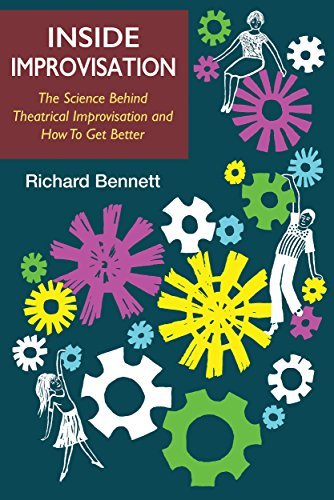
A switch of focus from failure to success would support the key insight of Richard Bennett’s Inside Improvisation: The Science Behind Theatrical Improvisation and How To Get Better (2019). Bennett states, “Improvisation is an awesome evolutionary mind hack,” which sets the scene for a fascinating trawl through history, making distinctions between different schools of improv and putting AI into context. This is astute: “Yet many of the exercises we use today in improvisation, teach us both spontaneity and scene progression at the same time, making them difficult to use in other nontheatrical domains without being adapted in some way. For example, a scene painting exercise will help with spontaneity, scene initiation and scene progression skills. The spontaneity aspect may be useful for training improvising jazz musicians for example however the visualization and storytelling aspects may not. Recognizing this gives us insight into how theatrical improvisation exercises can be adapted into other domains including applied improvisation.” It’s a pioneering book, worth reading despite (or perhaps because of) its muddled mix of sense and nonsense; acute perception and irritating repetition (where was the editor when needed?). Typically, he’ll make an accurate observation, followed by a bold and ridiculous claim, which I guess he needs to justify his obsession with brain science. For example, “With the increased use of applied improvisation — improvisation used as a tool for life, business or other creative endeavours — the way improvisation is taught is changing. Eventually, teaching the first principles won’t begin with being in the moment, being fearless, and playing classic theatre games and exercises while facing out behind the fourth wall. The first principles will soon be what happens in our brains, and how that leads to and supports spontaneity and improvisation.”
Absolutely no need to drag neuroscience in here. I’d think it considerably more likely that the first principles will be derived from what we observe of improvisation in the applied settings. So, what have we discovered? Well, there’s a lot to read, either to learn more about the basics or to prompt discussion and even argument from the more experienced practitioners. And for writers, a message that the bookshelf still has plenty of room for your contributions – especially if you are a clear and original thinker, with insight into the significant differences between the safety of an improv workshop and the higher stakes environments of personal and organizational lives.
About the Author: Paul Z JacksonPaul Z Jackson is editorial advisor and editor of the Applied Improvisation Magazine and author of books about improvisation, including Impro Learning, 58½ Ways To Improvise In Training and Easy: Your LIFEPASS to Creativity and Confidence. He is cofounder and former board member of the AIN. Paul lives in Oxford, UK. (Read more from our magazine issues: click here to access our article database.) (Last Updated: Thursday, January 29th, 2026) |